
The more studies, the more robust the foundation of evidence… and from there it keeps building!
SUMMARY OF OUTCOME RESEARCH
HOLOGRAPHIC REPROCESSING
17 outcome studies including 14 randomized clinical trials (RCT) including comparisons to Prolonged Exposure, Cognitive Processing therapy, and Dialectical Behavioral therapy found Holographic Reprocessing to be as effective in reducing symptoms of PTSD, anxiety, depression, and negative thinking as gold standard treatments and superior to control groups with very low dropout rates.
Holographic Reprocessing is also associated with improved positive factors such as secure attachment, cognitive flexibility, emotion regulation, general health, and post traumatic growth. It has also been found to improve a fighting spirit in cancer patients.
Studies have been conducted with male and female veterans, civilians, and adolescents, in the United States, and in the Middle East.
Selected Conference Posters
Click image to enlarge

WARRIOR RENEW
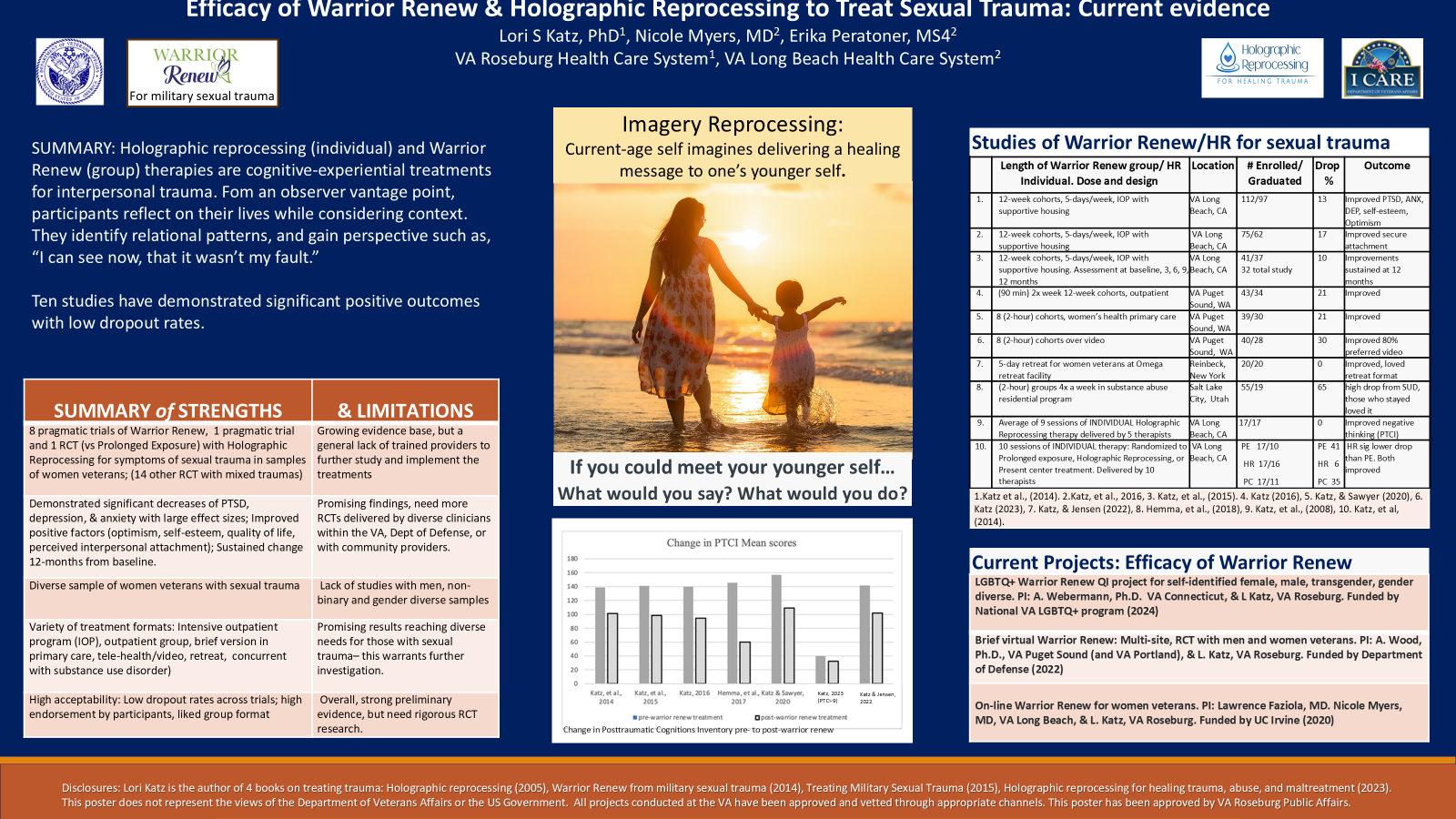
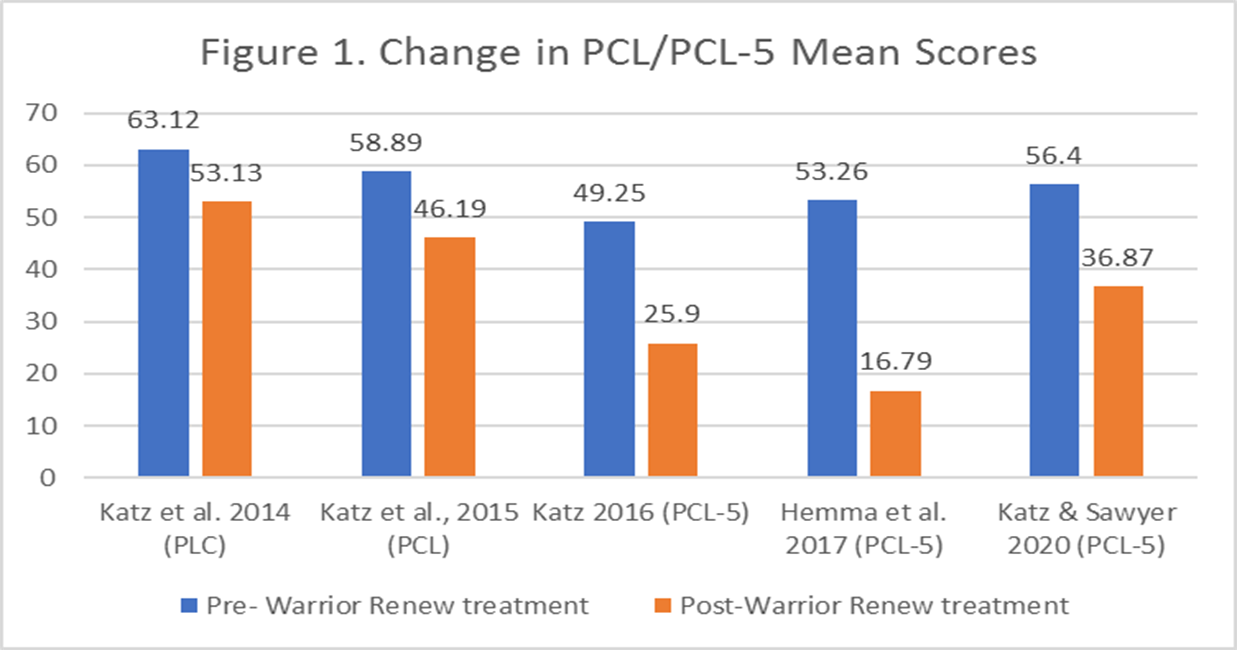
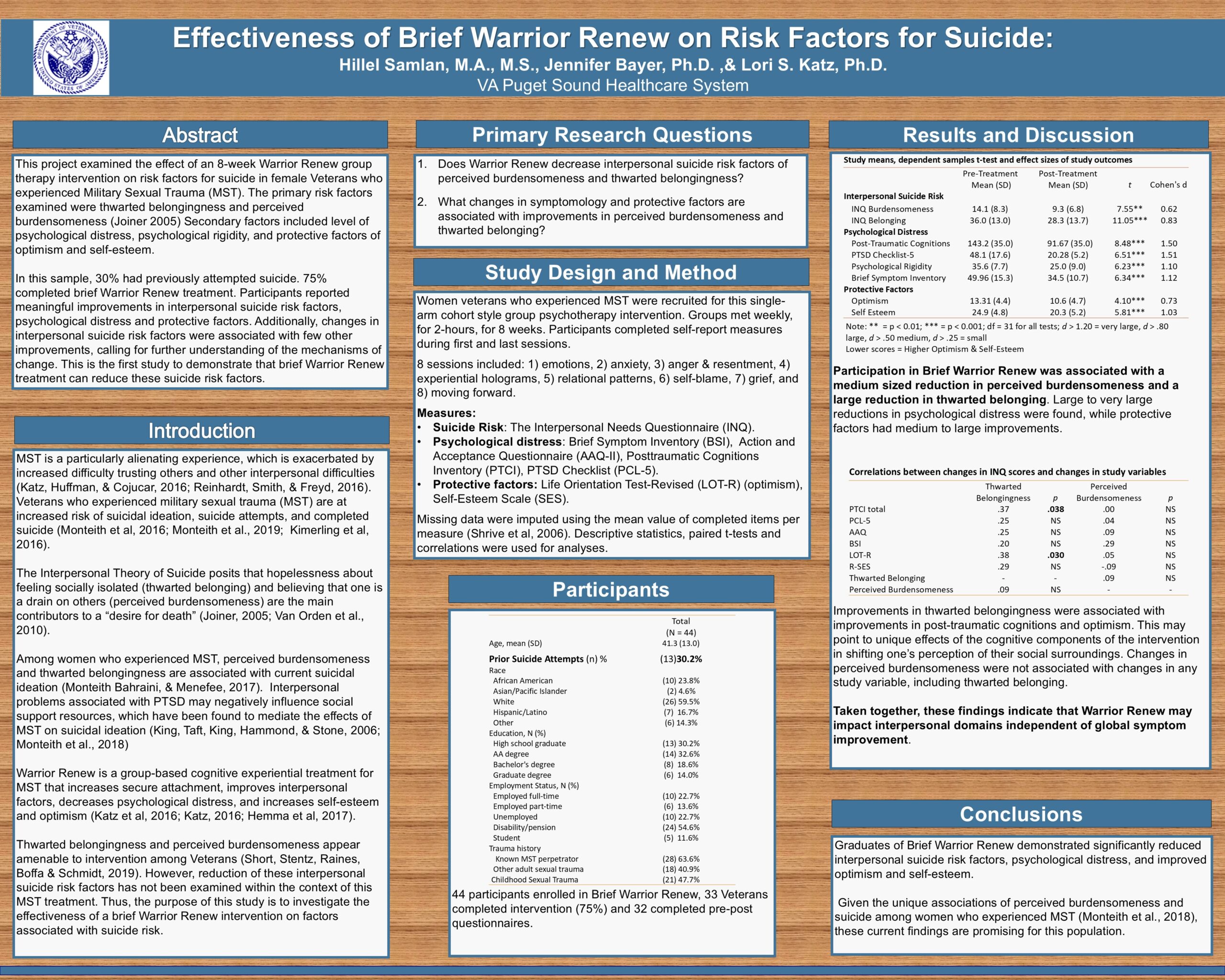
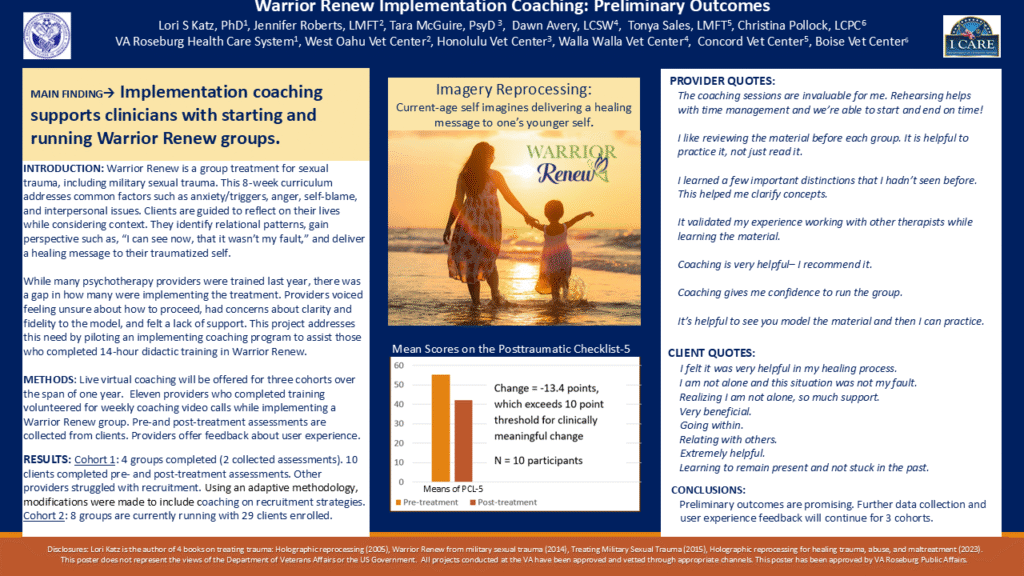
10 outcome studies 1 RCT found decreased symptoms of PTSD, anxiety, depression, and negative thoughts. Warrior Renew has also been associated with increased self-esteem, secure attachment, optimism, & satisfaction with life with medium to very large effect sizes.
Studies have had remarkably low dropout rates. A long-term follow up study found results were maintained a year from baseline with continued improvement in satisfaction with life.
Warrior Renew has been researched in a 12-week intensive outpatient program, outpatient group, 8-session group, and in a residential substance abuse program. It has been used in a week-long retreat, and delivered in women’s, men’s, and TGD/LGBTQ+ groups.
space
space
Relevant Publications
WARRIOR RENEW
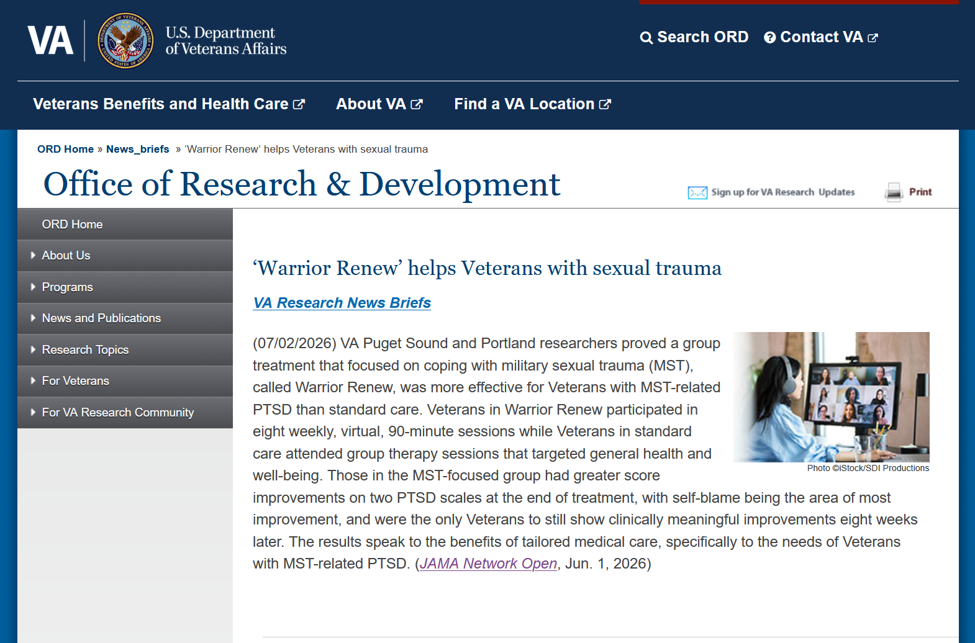
Wood AE, Zaccari BA, Hee Wai TY, Crooker MN, Evanisko MS, Clark JB, Sewell JB, Silverman SC, Dolph SJ, Katz LS. (2026). Group Therapy for Posttraumatic Stress Disorder Symptoms Among Veterans with Military Sexual Trauma: A Randomized Clinical Trial. JAMA Netw Open. 9(6):e2618896. Doi:10.1001/jamanetworkopen.2026.18896
Katz, L. (2023). Delivering brief Warrior Renew over video teleconferencing to women veterans with military sexual trauma: A pragmatic trial, Psychological Services, 20(4), 789-797. doi: 10.1037/ser0000786. Epub 2023 Jun 22. PMID: 37347914
Katz, L.S., & Jensen, G. (2022). Outcomes of a five-day Warrior Renew retreat to reduce symptoms related to military sexual trauma for women veterans. Journal of contemporary psychotherapy. https://doi.org/10.1007/s10879-022-09545-8
Katz, L.S., & Sawyer, W.N. (2020). Pragmatic Trial of Brief Warrior Renew Group Therapy for Military Sexual Trauma in VA Primary Care. Psychological Services, 17(4), 433–442. https://doi.org/10.1037/ser0000325
Hemma, G., McNab, A., & Katz, L. (2018). Efficacy of sexual trauma treatment in a substance abuse residential program for women, Journal of contemporary psychotherapy, 48 (1), 1-8, DOI 10.1007/s10879- 017- 9365-8
Katz, L. (2016). Efficacy of Warrior Renew group therapy for female veterans who have experienced military sexual trauma, Psychological Services, Vol 13(4), 364-372.
Katz, L., Park, S., Cojucar, G., Huffman, C, & Douglas, S. (2016). Improved attachment style for female veterans who graduated Warrior Renew sexual trauma treatment. Violence and Victims, 31 (4), 680-691.
Katz, L. Cojucar, G., Hoff, R., Lindl, C., Huffman, C. & Drew, T. (2015). Longitudinal outcomes of Renew: A sexual trauma treatment program for women Veterans, Journal of Contemporary Psychotherapy, 45(3), 143- 150.
Peak, N. J. (2015). Holographic Reprocessing as a Treatment for Military Sexual Trauma, Journal of Contemporary Psychotherapy, 45(3) DOI: 10.1007/s10879-015-9301-8 (review of Warrior Renew)
Landes, A.T., (2015). Sexual trauma, holographic reprocessing, and the military. PsycCRITIQUES, 60(41) DOI: 10.1037/a0039750 (Review of Warrior Renew)
Katz, L. (2014). Warrior Renew: Healing Military Sexual Trauma, Springer, New York.
Katz, L., Cojucar, G., Douglas, S., & Huffman, C. (2014). Renew: An integrative psychotherapy program for women Veterans with sexual trauma. Journal of Contemporary Psychotherapy 44 (3): 163-171.
HOLOGRAPHIC REPROCESSING
Katz, L.S. (2023). Holographic Reprocessing for Healing Trauma, Abuse, and Maltreatment (1st ed.). Routledge. https://doi.org/10.4324/9781003223429 (October 9, 2023)
Eftekhari A, Bakhtiari M, Arani AM. (2022). The effectiveness of holographic reprocessing therapy (HR) on the avoidance, intrusions and hyperarousal symptoms in PTSD patients. Medical Science, 2022, 26, e2024.
Aghajani S, Khoshsorour S, & Taghizadeh Hir S. (2021). The Effectiveness of Holographic Reprocessing Therapy on Cognitive Flexibility and Posttraumatic Growth in Women with Breast Cancer. J Arak Uni Med Sci., 24 (1). URL: http://jams.arakmu.ac.ir/article-1-6471-en.html
Salehi, M., & Beshlideh, K. (2020). The Effectiveness of Holographic Reprocessing Therapy on Cognitive Flexibility, Affective Control and Social Adjustment on Depressive patients with Attempted Suicide in Ilam City. Counseling Culture and Psychotherapy, 11(43), 183-216. doi: 10.22054/qccpc.2020.50615.2338
Salehi, M., Beshlideh, K., & Kazemzade. K. (2020). Effectiveness of Holographic Reprocessing therapy on cognitive emotion regulation strategies and impulsivity of women attempted suicide in Ilam City. Quarterly Journal of Women and Society, 11, e17192. https://doi/org/1001.1.20088566.1399.11.43.9.7.
Katz, L. (2019). Holographic Reprocessing Couple therapy with military couples, In (ED.) Pitta, P. & Datchi, C. Integrative couple and family therapy: Treatment models for complex clinical issues, American Psychological Association, Washington DC.
Salehi, M., Hamid, N., & Beshlideh, K., & Arshadi, N. (2019). Comparison of the Effectiveness of Holographic Reprocessing and Dialectical Behavioral Therapy on Cognitive Flexibility and Impulsivity among Depressed Patients with a Suicide Attempt in Ilam, Iran. Journal of Ilam University of Medical Sciences. 27(5) 1-14. DOI: 10.29252/sjimu.27.5.1.
Rezapour, M., & Zakeri, M. (2019). The effectiveness of holographic re-treatment on the meaning of life, fear of negative evaluation and rumination of depressed women, Counseling Culture and Psychotherapy, 10 (3900588), 49-70.
Narimani, M., Kazemi, N., & Basharpoor, S. (2019). The Effectiveness of Holographic Reprocessing on General Health and Cognitive Emotion Regulation in Female Divorce Applicants Referred to Bijar County Court in 2015-2016: An Educational Trial, Journal of Rafsanjan University of Medical Sciences and Health Services, 18 (3), 237-250.
Salehi, M., Naami, A., & Kazemi, N. (2019). Effectiveness of holographic reprocessing on affective control and difficulty in emotion regulating of Women Applicants for the Divorce Faced with Infidelity, Journal Quarterly Journal of Women and Society, 9 (36), 197-216.
Kasai N., & Narimani, M., & Basharpoor, S. (2018). The Effectiveness of Holographic reprocessing therapy in improving traumatic memories and post-traumatic cognitions of women claiming divorce. Counseling Journal, 15 (61), 35-37.
Mehrparvar S, Hajloo N, & Aboolghasemi A. (2017) The effectiveness of Holographic Reprocessing Therapy on mental adjustment to cancer in women with cancer. Studies in Medical Sciences. 28 (5) :343-352. URL: http://umj.umsu.ac.ir/article-1-3923-en.html
Otared, N, Borjali, A. Sohrabi, F., Basharpoor, S. (2016). Efficacy of Holographic Reprocessing on arousal and intrusion symptoms in veterans with posttraumatic stress disorder, Studies in Medical Sciences, 27 (5), 427-437
Katz, L., Douglas, S., Zaleski, K.,Williams, J., Huffman, C., & Cojucar, G., (2014). Randomized clinical trial comparing Holographic Reprocessing and Prolonged Exposure to Person-centered therapy to treat women Veterans with sexual trauma. Journal of Contemporary Psychotherapy, 44(1) 9-19.
Narimani, M., Basharpoor, S., Gamarigive, H., & Abolgasemi, A. (2013). Impact of cognitive processing and holographic reprocessing on posttraumatic symptoms improvement amongst Iranian students. Advances in Cognitive Science, 15(2)[58], 50–62.
Narimani, M., Basharpoor, S., Gamarigive, H., & Abolgasemi, A. (2011). Effectiveness of Cognitive Processing Therapy and Holographic Reprocessing on the Reduction of Psychological Symptoms in Students Exposed to Trauma. Journal of Clinical Psychology, 3 (11), 41-53.
Katz, L. Snetter, M., Hagler, A., Hewitt, P., & Cojucar, G. (2008). Holographic Reprocessing: Empirical evidence to reduce posttraumatic cognitions in women Veterans with PTSD from sexual trauma and abuse, Psychotherapy: Theory, Research, Practice, and Training, 45(2,) 186-198.
Katz, L. (2007). What is Holographic Reprocessing? Los Angeles Psychologist, Sept/Oct issue.
Katz, L. (2005). Holographic Reprocessing: A cognitive-experiential psychotherapy for the treatment of trauma. Brunner-Routledge, New York.
Katz, L. (2001). Holographic Reprocessing: A cognitive-experiential psychotherapy for the treatment of trauma, Psychotherapy: Theory, Research, Practice, and Training, 38, (2), 186-197.
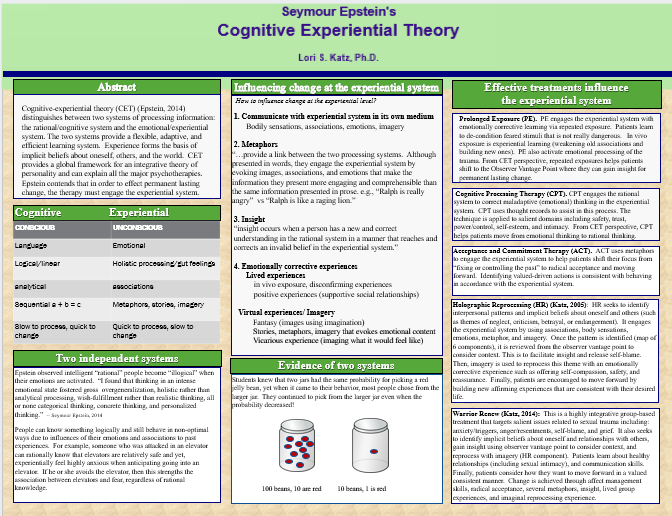
COGNITIVE-EXPERIENTIAL THEORY
Epstein, S. (2014). Cognitive Experiential Theory: An integrative theory of personality, Oxford University Press, New York.
Norris, P. & Epstein, S. (2011). “An experiential thinking style: Its facets and relations with objective and subjective criterion measures”. Journal of Personality. 79: 1044–1080.
Epstein, S. & Pacini, R. (2001). The influence of visualization on intuitive and analytical information processing. Imagination, Cognition, and Personality, 20, 195–216.
Pacini, R., Epstein, S. (1999). The relation of rational and experiential information processing styles to personality, basic beliefs, and the ratio-bias phenomenon. Journal of Personality and Social Psychology,76, 972–987.
Epstein, S. (1994). Integration of the cognitive and the psychodynamic unconscious. American Psychologist, 49, 709–724.
Denes-Raj & Epstein, S. (1994). Conflict between experiential and rational processing: When people behave against their better judgement, Journal of Personality and Social Psychology, 66, 819-829.
Kirkpatrick, L. & Epstein, S. (1992). Cognitive-experiential self-theory and subjective probability: Further evidence of two conceptual systems, Journal of Personality and Social Psychology, 63, 534, 544.
Epstein, S. & Katz, L. (1992). Coping style, stress, productive load, and mental and physical well-being, Journal of Personality and Social Psychology, 62, 813-825.
Katz, L. & Epstein, S. (1991). Constructive thinking and coping with laboratory-induced stress, Journal of Personality and Social Psychology, 61, 789-800.
Epstein, S. & Meier, P. (1989). Constructive thinking: A broad coping variable with specific components, Journal of Personality and Social Psychology, 57, 332-349.
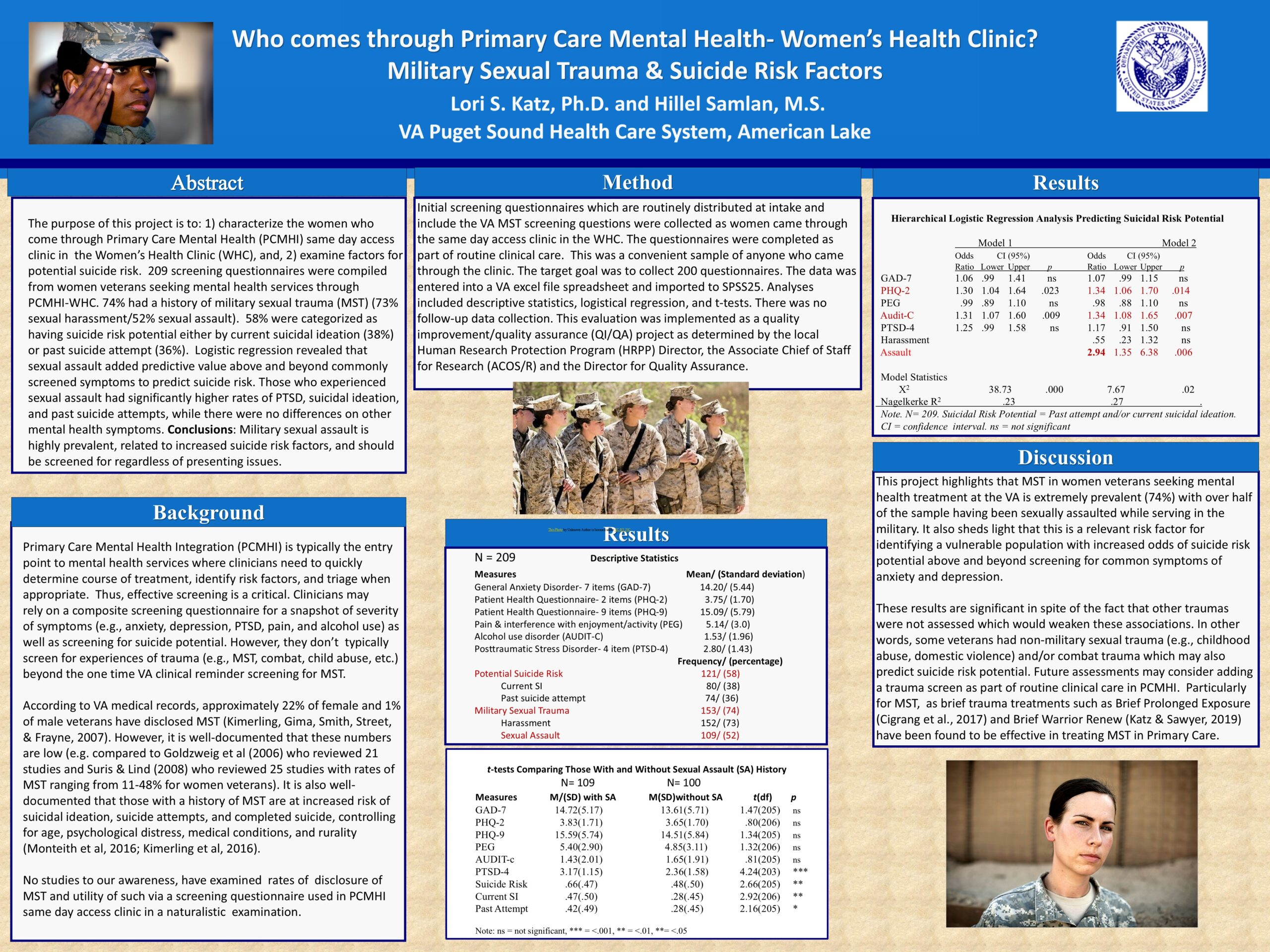
MILITARY SEXUAL TRAUMA
Katz, L. Huffman, C., & Cojucar, G. (2016). In her own words: Semi-structured interviews of women veterans who experienced military sexual trauma. Journal of contemporary psychotherapy, 47(3), 181-189.
Katz, L. (2015). Treating Military Sexual Trauma, Springer, New York.
Zaleski, K, & Katz, L. (2014) Alice in Wonderland: Exploring the experience of female services members with a pregnancy resulting from rape. Social Work in Mental Health, 12: 391- 410.
Pence, P., Katz, L., Huffman, C., & Cojucar, G. (2014). Delivering Integrative Restoration-Yoga Nidra Meditation (iRest) to women with sexual trauma at a Veteran’s Medical Center: A pilot study, International Journal of Yoga therapy, No 24: 53-62.
Katz, L. Cojucar, G., Beheshti, S., Nakamura, E., & Murray, M. (2012). Military sexual trauma during combat: Prevalence, readjustment, and gender differences in those deployed in the conflicts in Iraq and Afghanistan, Violence and Victims, 27 (4), 487-499.
Luterek, J., Bittinger, J. N., & Simpson, T. K. (2011). Posttraumatic sequelae associated with Military sexual trauma in female veterans enrolled in VA outpatient mental health clinics. Journal of Trauma and Dissociation, 12, 261–274.
Turchik, S., & Wilson, S. M. (2010). Sexual assault in the US military: A review of the literature and recommendations for the future. Aggression and Violent Behavior, 15, 267–277
Suris, A., & Lind, L. (2008). Military sexual trauma: A review of prevalence and associated health consequences in veterans. Trauma, Violence, and Abuse, 9(4), 250–269.
Katz, L., Bloor, L., Cojucar, G., & Draper, T. (2007). Women who served in Iraq seeking mental health services: Relationships between military sexual trauma, symptoms, and readjustment. Psychological Services, 4(4) 239-249.
ATTACHMENT THEORY
Wallin, D. (2007). Attachment in psychotherapy, New York, NY, Guildford Press.
Ainsworth, M. D. (1969). Object relations, dependency, and attachment: A theoretical review of the infant-mother relationship. Child Development, 40, 969–1025
ADJUSTMENT FROM DEPLOYMENT
Katz, L., Cojucar, G., Davenport, C., Clarke, S., & Williams, J., (2012). War Experiences Inventory: Reliability, validity, and scoring of a new measure to assess war-related experiences, Military Psychology, 24, 48-70.
Katz, L., & Williams, J. (2012). Post-deployment readjustment: Assessment and clinical issues, In (Eds.) Kaur, G., Psychometric testing in Armed Forces: Issues and challenges, Delhi.
Katz, L., Cojucar, G., Davenport, C., Pedram, C. & Lindl, C. (2010). Post Deployment Readjustment Inventory: Reliability, validity, and gender differences, Military Psychology, 22, 41-65.
